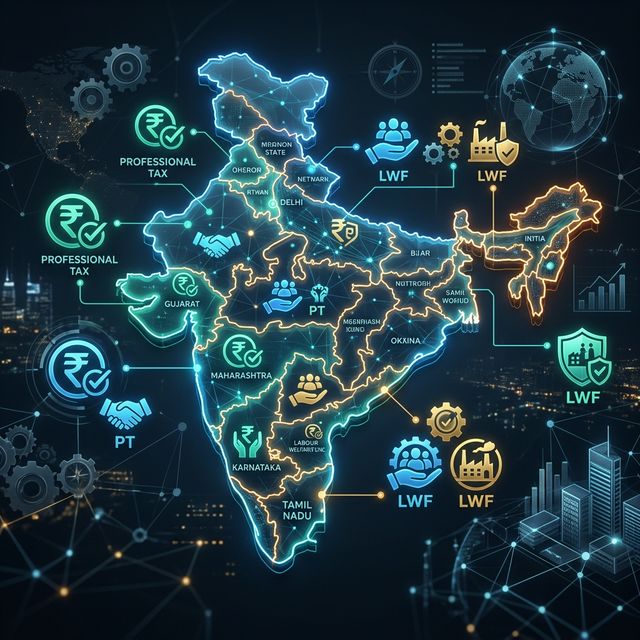
Multi-State Payroll in India: PT & LWF Rules 2026
The Geographic Chaos of Remote Work in 2026
As we step into 2026, the "Standard Office" model has officially been replaced by the "Sovereign Workforce." For any modern Indian startup, your best engineer might be in Bengaluru, your head of sales in Mumbai, and your marketing lead in a serene home office in Jaipur. While this distributed model aggressively unlocks a massive talent pool, it simultaneously creates a legislative nightmare for your payroll department. Operating a multi-state payroll compliance structure across the vastly different state laws of India is arguably the most significant administrative challenge for growing MSMEs.
Unlike centralized federal statutes like EPF and ESIC, which we've detailed in our startup payroll compliance guide, Professional Tax (PT) and Labor Welfare Fund (LWF) are hyper-localized. Every single state in India has the sovereign right to dictate its own tax slabs, deduction schedules, and registration requirements. This guide systematically maps the 2026 landscape of state-level deductions to ensure your distributed team stays airtight and legal.
Professional Tax (PT): The "Income on Profession" Tax
Professional Tax is a state-level direct tax imposed on any individual who earns an income from a salary or by practicing a profession. While the maximum amount any state can legally charge is capped at ₹2,500 per annum, the specific slabs vary wildly based on your employee's registered state of residence. If you are still relying on a basic online payroll calculator that doesn't account for state-wise drift, you are in danger of falling into exactly what we describe in our analysis of the true cost of human error.
1. Maharashtra Professional Tax Slabs 2026
Maharashtra remains one of the most proactive states in PT collection. In 2026, the standard slabs for salaried employees include:
- Up to ₹7,500: Nil deduction.
- ₹7,501 to ₹10,000: ₹175 per month.
- Above ₹10,000: ₹200 per month (except for February, where it is ₹300).
2. Karnataka PT Registration & Rules
In the tech capital of Bengaluru, PT registration Karnataka is a first-day requirement for startups. The 2026 slab is straightforward but must be executed perfectly:
- Earnings up to ₹14,999: Zero deduction.
- Earnings ₹15,000 and above: ₹200 per month.
3. Other Major States (Tamil Nadu & West Bengal)
Tamil Nadu utilizes a half-yearly (binary) deduction system rather than a monthly one, which often trips up founders who automate MSME payroll without localized logic. West Bengal, on the other hand, has a multi-tier slab system that reaches the ₹2,500 cap much faster. Maintaining an updated Gujarat professional tax online portal account is also essential if you have operations in the manufacturing hubs of the West. If you find this overwhelming, it is time to retire those manual Excel habit for good.
Labor Welfare Fund (LWF): The Silent Statutory Deduction
The Labor Welfare Fund (LWF) is a state-managed social security fund designed to provide welfare services to industrial and commercial workers. Similar to PT, LWF is not applicable in every state (e.g., it is absent in Rajasthan and Uttar Pradesh currently). When it is applicable, it involves a contribution from both the employer and the employee, usually collected either monthly, half-yearly, or annually.
For example, Tamil Nadu LWF rules 2026 mandate a small annual contribution (often around ₹60), which must be reported with surgical precision. While the monetary value is nominal, the non-compliance penalties for missing an LWF filing can be surprisingly aggressive. An automated free salary slip maker ensures these tiny, state-specific nuances never slip through the cracks of your administrative workflow.
Navigating the 2026 Compliance Strategy
To successfully manage a distributed team in 2026, every Indian startup should:
- Register for PT in every state you have employees: Unlike ESIC, which is tied to your office address, PT is often tied to where the employee is actually working.
- Audit Your "Last Drawn Salary" Definitions: Different states have different definitions of "Gross Salary" for PT calculations. Using a premium payslip generator for India that handles these specific mappings is the only way to scale without adding more HR headcount.
- Monitor Section 115BAC Opt-ins: While PT is deductible from gross income before calculating income tax, the New Tax Regime rules have slightly changed how these deductions are reported for certain salary brackets.
Conclusion: The Future of Frictionless Payouts
Geographic borders are disappearing in the Indian tech world, but legal borders are becoming sharper and more automated. Don't let a state-level PT notice slow down your startup's momentum. By successfully transitioning your multi-state payroll compliance to a cloud-native platform, you turn a complex, multi-state maze into a single, unified dashboard. Embrace the decentralized workforce with total confidence and zero administrative anxiety. Your team builds the future; let your software handle the borders.