Section 115BAC Explained: New vs Old Tax Regime
The Dawn of Highly Complex Dual Tax Frameworks
When the prestigious Government of India proudly introduced the highly debated Section 115BAC new tax regime to the massive Income Tax Act, it fundamentally and permanently terraformed the entire landscape of personal employee finance and Indian payroll compliance mechanics. By aggressively introducing an entirely new, highly streamlined alternative tax track, they effectively shattered decades of established, complex deduction strategies, actively creating a highly engaging, yet deeply confusing, critical financial choice for salaried professionals across the nation.
For aggressive founders and busy HR operators actively attempting to automate MSME payroll processes cleanly, intimately understanding the nuanced old vs new tax regime India comparison is absolutely critical. As the incorporated employer systematically responsible for calculating and legally withholding Tax Deducted at Source (TDS) perfectly every single month, keeping an iron grip on these shifting regimes is fundamentally necessary to ensuring compliance.
The Old Tax Regime (The Strategy Route)
The Old Tax regime fundamentally represents the highly traditional, heavily structured methodology of historical Indian taxation. It is structurally heavily defined by significantly higher base tax slabs mathematically, but it famously and generously rewards informed citizens who actively lock up their capital in long-term financial instruments and essential life expenditures.
Under this specific regime, highly educated salaried employees can actively carve out massive reductions in their taxable baseline income. Professionals heavily utilize Section 80C (historically capped at up to ₹1.5 Lakhs) via stable instruments like Equity Linked Savings Schemes (ELSS) and Public Provident Funds (PPF). These are core concepts critical to successfully managing the broader larger statutory compliance guidelines ecosystem. It generously rewards strategic foresight, strongly guaranteeing the absolute lowest overall tax output for heavy, disciplined investors.
The New Tax Regime (The "Streamlined Simplicity" Route)
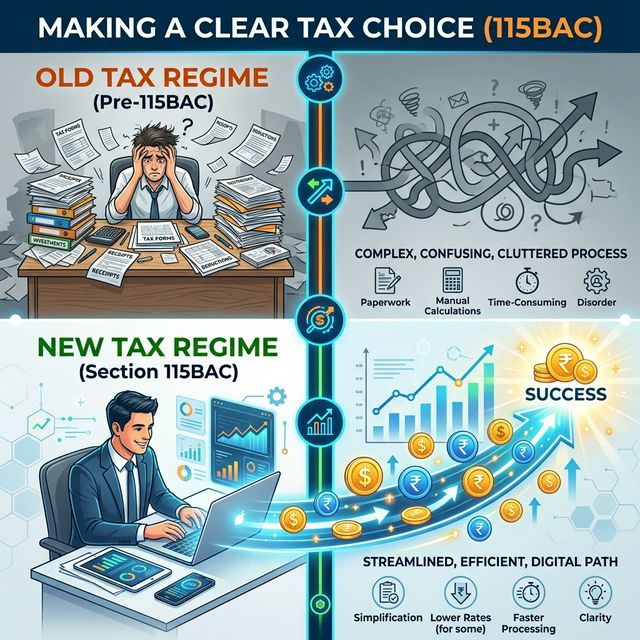
Openly recognizing the brutal, punishing complexity of gathering 80C declarations and verifying physical rent receipts, the government impressively formulated the New Tax Regime to offer stark, unbridled simplicity to the masses. It is incredibly important to actively note that the New Tax Regime is now designated natively as the "Default Regime" by the demanding Income Tax Department unless explicitly opted out by the employee.
The New Regime achieves widespread simplicity by aggressively stripping away approximately 70 commonly used classical deductions and exemptions—meaning HRA, LTA, standard 80C investments, and heavy home loan interests on self-occupied properties are rendered totally useless here. However, it brilliantly compensates for this massive loss by actively offering drastically reduced, highly attractive flat tax slab rates, completely masking the devastating need to use old workflows that contribute to exactly what we highlight in our article on the true cost of dangerous manual processes.
The Ultimate Question: Which is Better?
The incredibly stark reality of navigating Section 115BAC is that there is absolutely no universal, generalized "correct" answer for everyone. The exact financial optimization hinges exclusively on an employee's exact mathematical salary bracket and their specific life stage.
- Who Exactly Chooses New? A young, 23-year-old brilliant junior engineer fresh out of an elite college typically carries absolutely zero massive investments, completely lacks a burdensome home loan mortgage, and deeply values incredibly high liquid cash-in-hand to aggressively fund their lifestyle. For them, the New Tax Regime is undeniably, overwhelmingly superior.
- Who Definitively Chooses Old? A 40-year-old highly senior corporate sales director with an ongoing massive ₹50 Lakh home mortgage, expensive children's high-tier tuition fees, maximum 80C capacity heavily reached, and aging beloved parents requiring high-premium health insurance policies will heavily rely on the Old Regime. The massive, compound deductions securely pull their high salary completely out of the punishing 30% upper tax bracket.
Flawlessly Automating the Great Debate
For an overburdened MSME or active Startup, sitting down and manually projecting accurate predictive TDS forecasts across both complex regimes for 50 distinct employees on a highly customized, fragile Excel sheet is effectively, statistically impossible. It warmly invites an avalanche of mathematical calculation errors and completely drains profound administrative energy, a phenomenon detailed heavily in our critical article investigating exactly why Excel is ruining your financial security.
Advanced modern platforms come completely fully loaded with a highly complex digital online payroll calculator that seamlessly calculates perfect parallel TDS estimations under both umbrellas simultaneously during the crucial onboarding phase. Even if you strictly just start utilizing a free salary slip maker to lightly test the platform's amazing capabilities, transferring that heavy architectural choice to the platform's advanced AI algorithms aggressively guarantees 100% compliance while empowering the employee entirely.