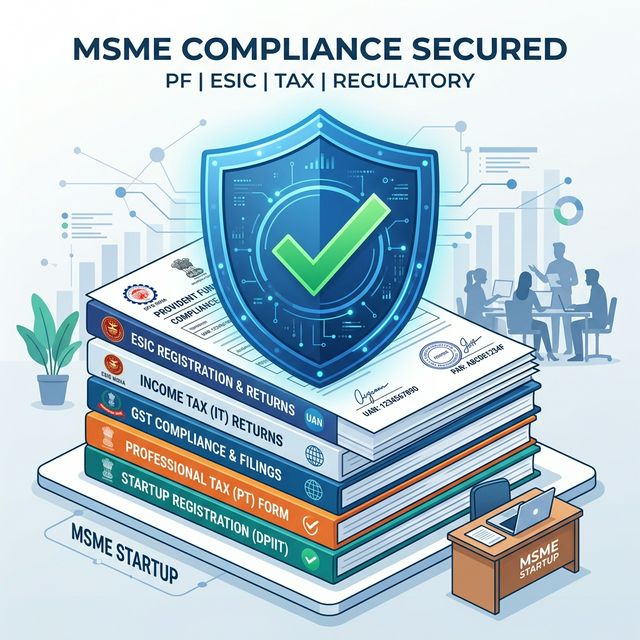
PF, ESIC & PT Explained: Indian Startup Guide

The Vital Importance of Absolute Compliance
When you transition from being an ambitious solopreneur into a formally registered company managing a rapidly exploding employee roster, the landscape of Indian federal labor laws can suddenly feel incredibly overwhelming and hostile. Keeping your startup payroll compliance immaculate isn't merely a bureaucratic hoop to jump through—it is an absolute foundational requirement for avoiding massive financial penalties, bypassing severe legal audits, and aggressively protecting the fundamental legal rights and financial stability of your employees. If you are still relying on human entry to track these dynamically shifting portals, we highly suggest you abandon spreadsheet calculations immediately.
This ultimate 2026 reference guide systematically breaks down the "Big Three" statutory requirements specifically tailored for Indian MSMEs: Employees' Provident Fund (EPF), Employees' State Insurance Corporation (ESIC), and Professional Tax (PT). We will detail exactly how modern SaaS architectures allow you to natively automate MSME payroll compliance effortlessly.
1. Employees' Provident Fund (EPF): Your Team's Future
The Employees' Provident Fund (EPF) is fundamentally a massive retirement benefits scheme governed strictly by the Employees' Provident Fund Organization (EPFO). Ensuring absolute perfection in your automated EPF compliance India is paramount for preserving your company's long-term operational health and averting deep legal investigations.
Applicability and Statutory Thresholds
Official registration under the EPF Act is strictly, legally mandatory for any organizational entity operating in India that actively employs 20 or more individuals. However, the modern startup ecosystem is incredibly competitive regarding talent acquisition. Many forward-thinking startups voluntarily opt-in to the EPF regulatory schemes long before they ever hit the 20-employee threshold. They do this to explicitly attract elite engineering talent and offer institutional-grade, highly secure financial benefits packages that rival massive corporate players.
The Intricate Contribution Mathematics
The EPF contribution mechanism is bipartite. Generally, the employee contributes exactly 12% of their calculated Basic Salary plus Dearness Allowance (DA). Simultaneously, the employer is legally mandated to match this with a corresponding 12% contribution. The EPFO is notoriously strict regarding remittance. Failing to systematically deduct or strictly failing to deposit collected EPF funds by the mandated portal deadline inevitably attracts severe compound interest penalties. Avoiding this financial nightmare is mathematically incredibly simple when you utilize a dedicated, modern digital system instead of manual counting.
2. Employees' State Insurance Corporation (ESIC)
The Employees' State Insurance (ESI) act is an incredibly vast, self-financing social security and federal health insurance scheme explicitly mandated for Indian workers. It is brilliantly designed to provide highly comprehensive medical care and socio-economic protection to middle-to-lower income employees and their immediate familial dependents during unfortunate times of sickness, maternity leave, or unexpected employment-related physical injury.
Navigating ESIC Limits 2026 and Beyond
The ESIC scheme is broadly applicable to non-seasonal factories or commercial software establishments officially employing 10 or more persons (notably raised to 20 in certain highly specific states). Crucially, the scheme explicitly caters to the protecting the lower-to-middle income bracket of the workforce. Being deeply aware of the exact updated ESIC limits 2026 is absolutely critical for your HR team: It is currently generally only applicable to employees whose gross monthly wages do not legally exceed ₹21,000 (extended to ₹25,000 for physically challenged individuals). The employer contributes a flat 3.25% of the total monthly wage, while the employee contributes a highly nominal 0.75%. Precision is everything here.
3. Professional Tax (PT): State-Level Complexity
Unlike EPF and ESIC, which operate flawlessly as centralized federal frameworks applied equally across the country, Professional Tax is a notoriously complex, hyper-localized state-level tax. It is imposed directly on the gross income earned by salaried employees. Because it is highly decentralized and rapidly shifting, maintaining updated professional tax slabs India manually in an offline document is a completely agonizing and highly dangerous administrative practice.
The Chaos of Geography in Remote Work
Because Professional Tax is governed autonomously at the explicit state level, the salary monetary slabs, deduction timings, and overall threshold limits vary wildly depending on exactly where your incorporated company—and increasingly your geographically removed remote employee—is officially registered and stationed. The slabs operating actively in Maharashtra look vastly different from those operating in Karnataka, Telangana, or West Bengal. Fortunately, smart cloud-native platforms automatically detect the employee's state and adjust this in milliseconds, which is precisely why strategic founders actively seek the best premium systems rather than doing the messy administrative work by hand.
Managing The Chaos: Subjugating Software Complexity
Let's speak frankly: Attempting to continually calculate, verify, and strictly track these distinct, ever-changing federal and state legislative thresholds manually is an exercise in immense financial risk management. A single seemingly minor update in a regional state budget can instantly render your massive Excel formula entirely obsolete, silently triggering a massive chain of illegal under-deductions. This specific vulnerability contributes incredibly heavily to the insidious true cost of manual payroll.
By heavily leveraging a modernized, robustly engineered free salary slip maker developed explicitly for Indian legal compliances, an MSME can fundamentally obliterate this structural dependency. The software accurately calculates EPF exactly to the decimal, flawlessly zeroes out the ESIC logic the millisecond the employee's gross salary breaches the ₹21,000 threshold, and correctly injects precisely calculated PT deductions instantly. Automate today to secure your company's operational compliance.