How to Automate Payroll for Indian MSMEs in 2026

The State of Indian Payroll Execution in 2026
Starting a business in India has never been more exhilarating, but managing the monthly payroll remains one of the most significant administrative burdens a founder has to face. The landscape of Indian compliance is vast, intricate, and deeply unforgiving of calculation mistakes. Between calculating complex basic salary algorithms, meticulously managing House Rent Allowance (HRA) and Leave Travel Allowance (LTA) exemptions, deducting Tax Deducted at Source (TDS), and ensuring foolproof EPF and ESIC compliance, the end of the month quickly turns into a high-anxiety calculation scramble that ruthlessly drains operational momentum from the core team.
Historically, small businesses and Micro, Small, and Medium Enterprises (MSMEs) have painfully relied on a deeply fragmented ecosystem of disorganized spreadsheets, physical paper ledgers, and disjointed corporate banking portals. However, as we step deeper into the hyper-competitive market of 2026, the absolute demand for agility, transparency, and instant, error-free compliance has made it critical to automate MSME payroll completely from day one. This comprehensive guide will explore exactly why your business needs to automate its financial architecture immediately and how to execute this transition flawlessly without disrupting your current operations.
Why Manual Spreadsheets Are Failing Your Business
Many Indian small businesses still rely on disjointed Excel grids or outdated, heavily localized offline software tools to calculate monthly salaries. If you want to understand the exact financial devastation this causes across your operations, you should read our extensive deep-dive on why it is mandatory to replace Excel payroll immediately.
The Hidden Cost of Human Error
Payroll is an incredibly emotional transaction for your team. When an employee receives their salary at the end of a hard month, they expect absolute mathematical perfection. A manual spreadsheet operation is highly susceptible to human error—a dragged VLOOKUP formula randomly breaking, a decimal point misplaced during data entry, or a forgotten attendance deduction due to a misread email. These seemingly minor errors can severely damage employee trust and morale, leading to a high attrition rate. Furthermore, errors in statutory deductions like TDS or PT (Professional Tax) can lead to frustrating and highly expensive compliance penalties from the Income Tax Department.
The Drain on Founder Time
Time is the singular most precious asset for any startup founder or agency owner. Spending three days at the end of every operational cycle individually verifying physical attendance sheets, calling the Chartered Accountant repeatedly to confirm the latest PF thresholds, and designing PDF salary slips manually is deeply inefficient. This massive loss of productivity forms the invisible cost of manual salary slips. The opportunity cost of manual administration is simply too high when you should be aggressively focusing on scaling your revenue models and client acquisition.
The Solution: Embracing Cloud-Based SaaS Automation
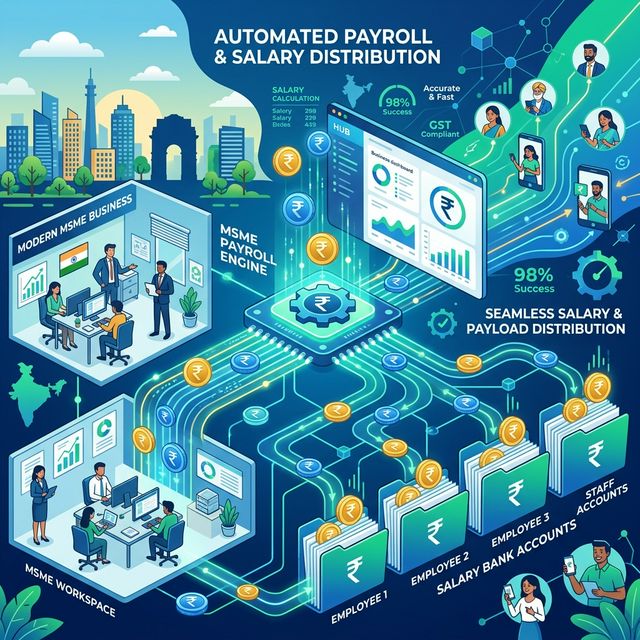
To truly scale your business operations and maintain a competitive edge, utilizing a dedicated, cloud-native startup payroll software is no longer a luxury; it is a fundamental necessity. Modern platforms are strictly built to handle the structural complexities of Indian payroll natively, effectively transforming a multi-day ordeal into a five-minute self-serve digital workflow.
1. Define Core Mathematical Formulas Just Once
The foundation of automated payroll is formally establishing your compensation structures digitally. By setting up your base salary logic, standard allowances (like LTA, HRA, Medical, and Special Allowances), and geographical considerations for regular employees just once during onboarding, the software intimately handles the rest forever. The foundational system remembers these structures month-over-month, allowing for scalable, repeatable calculation cycles that do not break even when new employees are onboarded.
2. Unprecedented Bulk Generation Architecture
Imagine generating perfectly formatted, professional, PDF-ready salary slips for your entire organizational roster—whether it consists of 5 employees or 250—in a single, satisfying click. Advanced platforms natively operate as a highly efficient bulk salary slip maker, allowing you to instantly trigger multi-employee PDF creation and securely distribute them via email or portals. This completely eradicates the archaic need to format individual Word documents ever again.
3. Instant and Masked Statutory Compliance
The core philosophy of a modern payroll engine is strictly "Zero Compliance Headaches". State-of-the-art platforms essentially act as an automated, completely free payslip generator India for early-stage startups while seamlessly calculating EPF, ESIC, and State-specific Professional Tax based on the absolute latest government brackets secretly behind the scenes. You simply don't need to track government gazettes anymore.
Transitioning Your Team: A Step-by-Step Approach
Switching from a legacy ledger system to a beautifully modern automated cloud tool is overwhelmingly simpler than most founders tentatively anticipate. If you are looking for specific advice on software procurement, we highly recommend reading our detailed guide on how to choose the best payslip generator for Indian startups. In the meantime, here is a streamlined, risk-free approach to transitioning your operations:
- Audit Your Current Organizational Roster: Methodically consolidate your existing employee data from existing sources. Ensure you possess absolutely accurate PANs, Universal Account Numbers (UAN), strict Dates of Joining, and formally structured compensation breakdowns.
- Choose Strict 'Self-Serve' Architecture: Aggressively avoid monolithic, legacy ERP platforms that mandate weeks of enterprise implementation and expensive consulting fees. Look for agile software properties like PaySlip Pro that allow you to simply sign up, input your CIN and GSTIN details, and start dynamically generating compliant slips within minutes.
- Run a Parallel Simulation Cycle: For the very first operational month, run your newly acquired automated software directly alongside your existing Excel process. Compare the net output files to aggressively build total confidence in the software's calculation logic, specifically regarding the heavy implications of the Section 115BAC tax regimes.
The Future of "Democratic Automation" in India
We are officially entering an era of "Democratic Automation", where vastly powerful, error-free financial engineering is no longer exclusively restricted to Fortune 500 companies armed with massive HR budgets. Modern cloud platforms are actively disrupting pricing, allowing micro-enterprises to access enterprise-grade calculation engines for a fraction of traditional enterprise costs. Stop manually wrestling with broken formulas, systematically eliminate your compliance anxiety, and start focusing entirely on what you truly do best: building and accelerating your business's growth engine.